The Wise Cat Perspective
Looking beneath the surface, every organisation is different, and every leadership team has its own ambitions, challenges and ways of working.
Yet after more than twenty-five years working alongside organisations at very different stages of growth, I noticed something that kept repeating itself.
The challenges leaders described were rarely as separate as they first appeared.
A communication problem often reflected a lack of clarity.
A culture concern frequently pointed towards leadership.
A performance issue was sometimes rooted in organisational design rather than individual capability.
The further I looked beneath the surface, the more connected these challenges became.
That observation became the foundation of the Wise Cat Perspective.

Seeing organisations differently
Most organisational conversations begin by asking a simple question:
"What is the problem?"
Our perspective begins somewhere different.
"What is really happening?"
Those are not the same question.
Rather than viewing leadership, communication, culture, performance and strategy as separate conversations, I have come to see them as parts of the same organisational system.
Understanding those relationships often changes the conversation completely. Solutions become more thoughtful, and decisions become more intentional.
Leaders gain confidence because they are responding to causes rather than symptoms.
Strategic Empathy
Over time, I realised there was a name for the way I had naturally begun to think.
Strategic empathy is the ability to understand people, systems, incentives, emotions, structures and outcomes at the same time. It recognises that organisations are rarely driven by process alone, or by people alone.
They are shaped by the interaction between both.
It is not a methodology, it is not a framework, it is simply a way of seeing organisations that helps leaders understand complexity more completely before deciding how to respond.
Diagnosis
Once you begin looking beneath the surface, patterns become easier to recognise.
Across organisations, similar dynamics appear again and again, even when the businesses themselves are very different.
Decision-making becomes harder, clarity gradually erodes, and leadership alignment becomes harder to maintain. Structures that once worked begin to struggle under the demands of growth.
On the Home page I introduce these as Organisational Patterns.
They are not intended to label organisations, but they aim to help leaders recognise familiar dynamics early enough to respond thoughtfully rather than reactively.
Culture Is Strategy
One belief has consistently shaped my work.
Culture is not something that sits alongside strategy. Culture is one of the ways strategy is experienced.
Leadership behaviours influence culture.
Culture influences decisions.
Decisions influence performance.
Performance influences the future of the organisation.
None of these conversations exist independently, and understanding those connections allows organisations to grow intentionally rather than accidentally.
The Wise Cat 3Cs
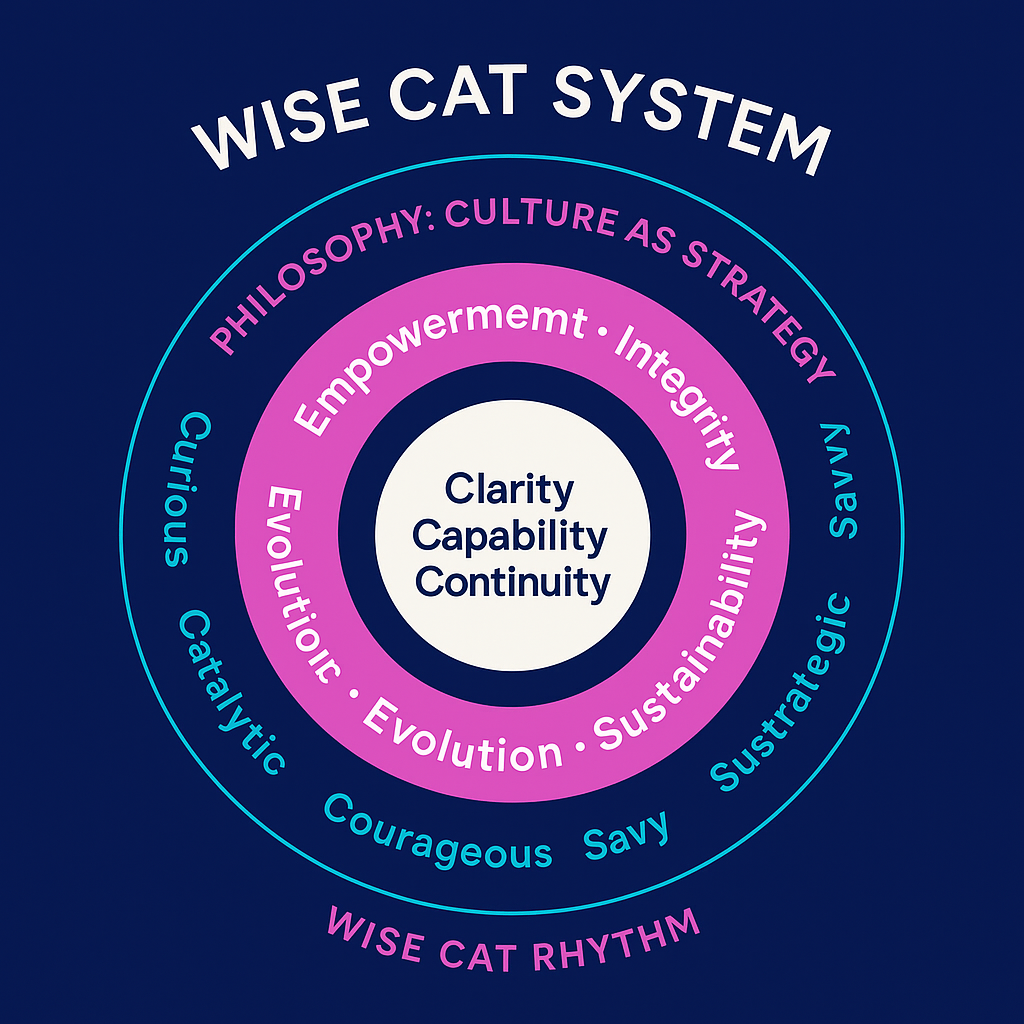
Clarity. Capability. Continuity.
Over the years, I found myself returning to the same three questions whenever I worked with leaders and organisations.
Is there clarity about what is happening?
Do we have the capability to respond effectively?
Can this be sustained over time?
Those questions became the foundation of the Wise Cat Model.
They are not intended to simplify organisational complexity, they provide a practical way of thinking about it.
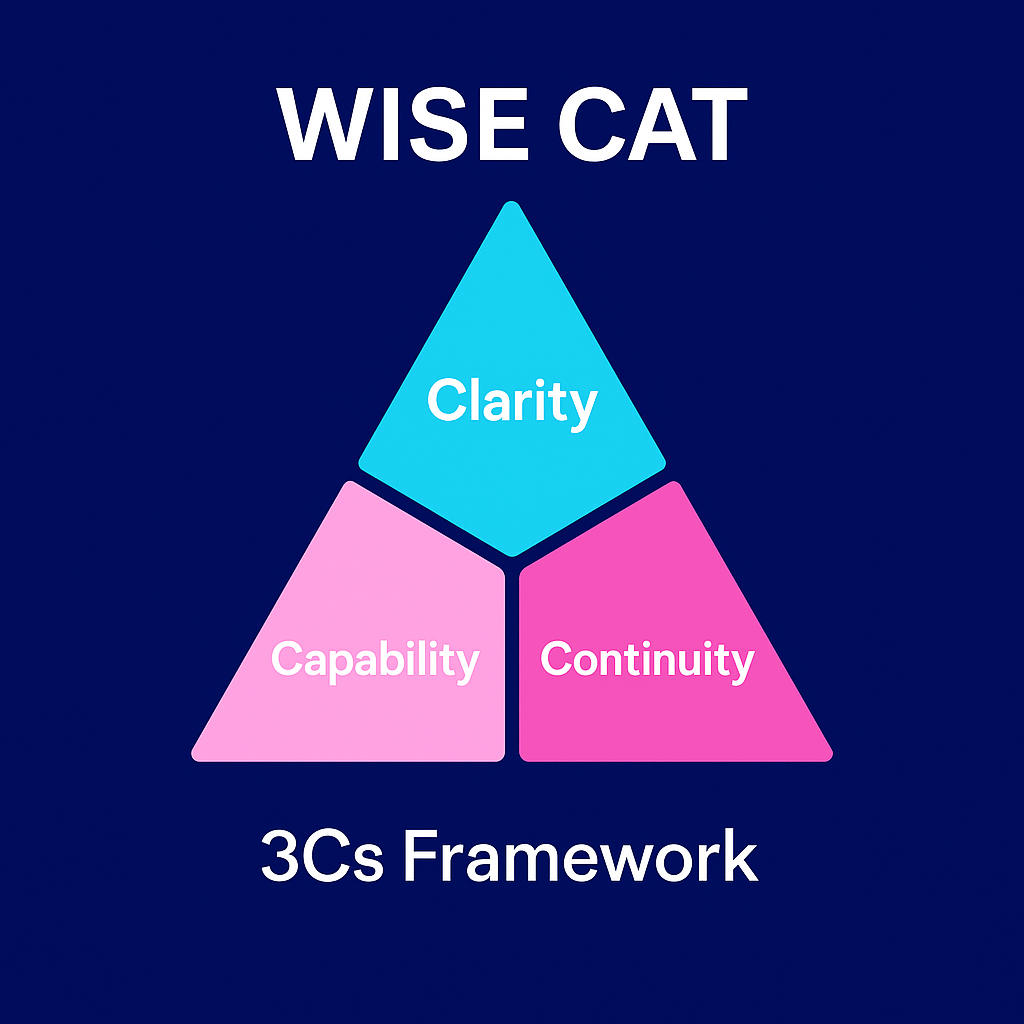
Clarity
Creating a shared understanding of reality, priorities and direction.
Without clarity, organisations spend unnecessary time interpreting information, making assumptions and working towards different outcomes.
Clarity creates confidence because people understand what matters and why.
Capability
Building the leadership, organisational and strategic capability required to succeed.
Growth asks more of organisations over time. Developing capability means strengthening not only skills, but also decision-making, leadership and the systems that support sustainable performance.
Continuity
Creating trust, resilience and momentum that can be sustained.
Organisations often focus on what needs to happen next. Continuity encourages leaders to consider what will allow success to continue over time.
Together, Clarity, Capability and Continuity provide a practical way of thinking about sustainable organisational growth without oversimplifying organisational complexity.
The Wise Cat Six
The Wise Cat Perspective influences not only how we understand organisations, but also how we choose to work with them.
Over time, six behaviours have become consistent across every conversation, every workshop and every advisory relationship. They are less about methodology and more about mindset.
Together, these behaviours describe the way I aim to show up in every conversation, every relationship and every engagement, and reflect the way I aim to work with every founder, leader and organisation.
CURIOUS: Creating clarity, movement and meaningful progress. The aim is not simply to analyse complexity, but to help leaders move forward with greater confidence.
SAVVY: Balancing insight with practical judgement. Ideas only become valuable when they help leaders make better decisions in the real world.
CATALYTIC: Seeking understanding before reaching conclusions. Curiosity creates better questions, deeper conversations and more thoughtful decisions.
STRATEGIC: Keeping one eye on today's challenges while never losing sight of tomorrow's opportunities. Good decisions solve immediate problems without creating unnecessary future ones.
COURAGEOUS: Addressing important issues thoughtfully, honestly and with respect. The most valuable conversations are often the ones people have been avoiding.
SUSTAINABLE: Creating approaches that organisations and people can maintain over time. Success is most valuable when it can be sustained.
A perspective that continues to evolve
The Wise Cat Perspective is not presented as the only way of understanding organisations, it is simply the perspective that has emerged through experience, curiosity and thousands of conversations with founders, leaders and teams.
It continues to evolve through every advisory relationship, every workshop, every speaking engagement and every Wise Cat Paper.
Because organisations continue to evolve, leadership continues to evolve, and so should the way we think about both.